News

If you’re a business owner, you might believe that rising energy costs are inevitable—like death and taxes. But the market forces at play in the utility industry have changed considerably over the past decade. Old-world problems were relatively simple, and they were resolved with simple solutions. New-world problems are more complicated and require a sophisticated response from smart business owners. The good news is that technology developers specializing in energy system automation and predictive controls, like Elexity, can help you understand why energy costs might be soaring and how you can bring them back under control.
Since 2000, much of the electricity in the US is split into wholesale and retail markets. In the wholesale market, utilities and other energy retailers bid at auction to procure power from generators and move power through the transmission system. Supply and demand sets prices, and demand has been rising fast as new large customers (particularly data centers training AI models) have come online. Many more such customers are forecast to enter the market over the next several years. As a result, wholesale market prices are rising at the fastest rate in many years.
A 2024 Elexity analysis showed that commercial electricity costs in California had risen more than 70 percent in a five-year span. Sadly, it's not just California businesses who are suffering.
A couple of nuances make recent trends even worse for commercial and industrial customers.
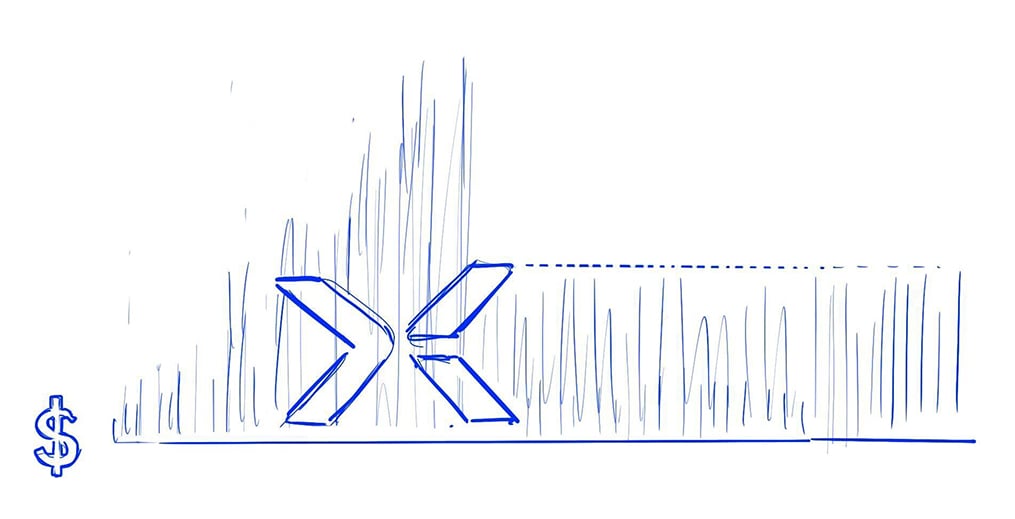
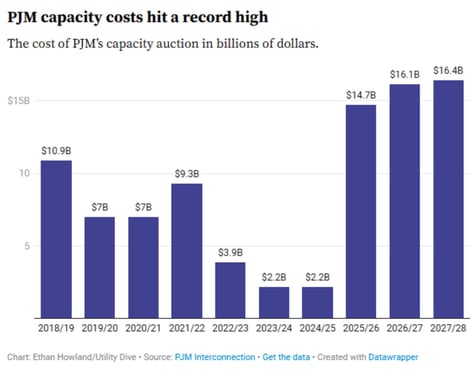
Wholesale markets set prices for energy as measured by kilowatt-hours (kWh) and power capacity measured by the maximum kilowatts (kW) required to deliver that energy. Energy costs are up, but capacity prices are going nuts. In the largest US wholesale market, PJM Interconnection serving some or all of 13 states centered around the Mid-Atlantic, the Midwest, and the District of Columbia, capacity costs are at record highs. While PJM might be an outlier, wholesale prices are rising nationwide.
It gets worse. At the retail level, decades of utility underinvestment in distribution system upgrades and maintenance have left communities in California, Colorado, Hawaii and beyond with aging power lines and rising costs to deal with the consequences, including remediation of wildfires traced back to faulty infrastructure. As a result, retail costs are rising too, with no end in sight.
Commercial energy users searching for ways to control costs are unlikely to find answers on the utility bill. I recently reviewed a utility bill for one of Elexity’s small-business customers. The bill showed 54 numbers representing usage, 49 with a dollar sign in front of them, and line items as meaningful as "CTC,” “NDC,” and “PPPC." (Yes, that was the entire description of the charge). In eight pages of jargon, abbreviations, and footnotes, there was no hint of an answer to the questions: "Why is this costing so much?" and "What can I do to drive down the bill?"
When I first began working with utility customers (my kids say this was when dinosaurs roamed the earth), my advice was simple. "To reduce your electric bill,” I’d say, “reduce the amount of energy you're using." The solution was simple because, for all but the largest industrial customers, energy charges made up the bulk of the bill. Few customers paid high demand charges or time-of-use rates. Use less, pay less. One-time expenses (e.g., conversions to LED lighting, building insulation projects) led to recurring reductions in energy usage and energy costs.
Now utility bills are rising, and complex billing makes it difficult for even relatively small commercial customers to understand why.
Here’s why: In many parts of the US, your time of use matters more than your total energy usage. For example, energy consumed from 4 to 5 p.m. can be five times more expensive than energy consumed an hour earlier. Similarly, high demand charges can mean that increased usage for one 15-minute interval could cost very little while increased usage another time could double the monthly bill.
Further, one-time investments like energy efficiency upgrades can no longer bring utility expenses back under control. So now when confronted with escalating energy costs, my advice is to procure automated systems with dynamic, real-time controls that can resolve complicated energy scenarios for you, like the Elexity energy management platform.
Advanced automation takes charge of energy decision making so business owners can do other things with their time. Teach the kids. Service the cars. Sell the shoes. You don’t want to run around turning air conditioners on and off all day based on changing electricity prices. Let an automated system do it for you.
These three steps can help get you started.
Schedule a meeting with our team in Boston to turn your energy expense into a strategic investment.